Technical walkthrough 01 · Robotics and evaluation
Robodex
A local robot-design workspace and an evaluation harness that freezes agent-produced files before independent structural and MuJoCo checks.
The interface could display more confidence than the backend earned
The workspace generates candidate robot morphologies and renders them in 3D. During review, I found that several visible signals were not qualification-grade: Candidate A was selected by default, multiple cards could project the same selected graph, and the workspace’s “simulation check” read stored flags instead of executing physics.
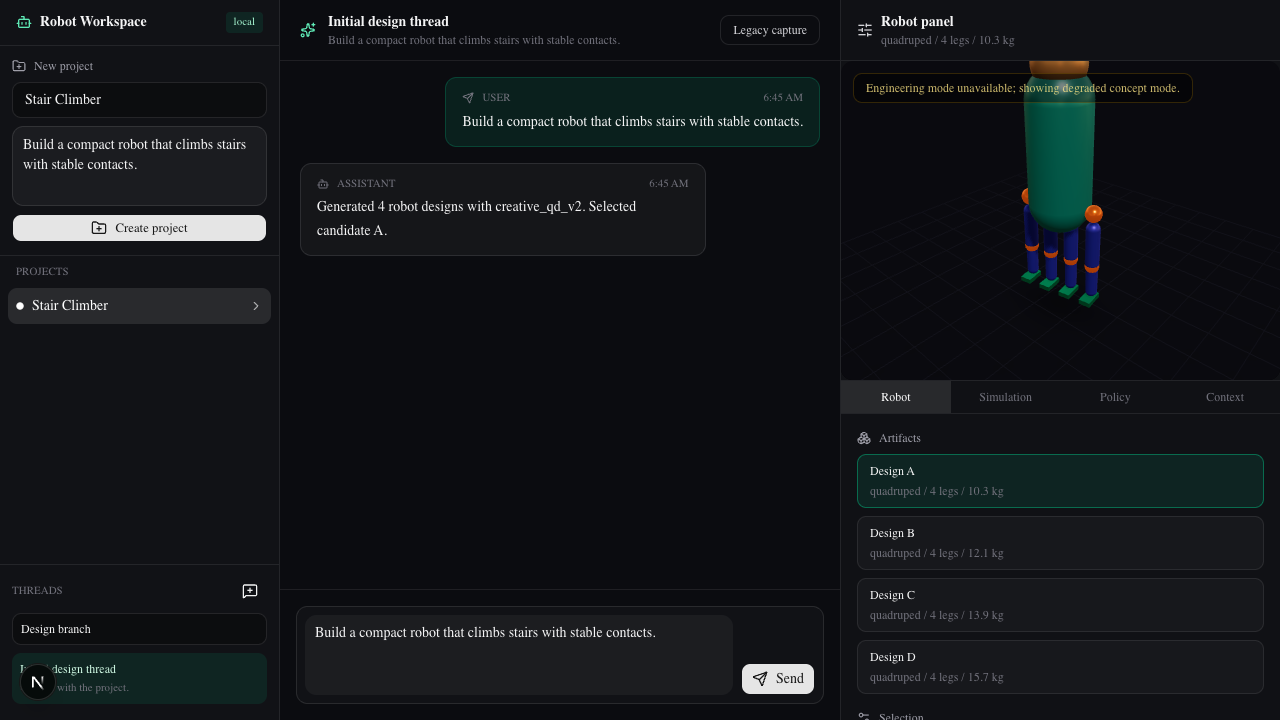
That audit changed the technical question. The evaluator now asks whether a final robot artifact passes checks that are outside the producing agent’s transcript and cannot be rewritten after the run.
What is frozen, what executes, and what gets compared
| Stage | Stored or executed result | Reason |
|---|---|---|
| Task load | Task revision, starter files, grader entrypoint | Prevents the prompt or acceptance test from moving between profiles. |
| Agent run | Profile, command, transcript, exit state, cost, runtime | Makes the complete setup—not only the model name—the comparison unit. |
| Freeze | Symlink-free file tree with path, byte size, and SHA-256 per file | Separates generation from judgment and detects later mutation. |
| Grade | Structural, compile/load, static, and behavior checks | Uses executable assertions instead of the agent’s explanation. |
| Replay | Digest of the task, grader, artifacts, state, failed IDs, and grades | Rejects a comparison if replay no longer matches the saved record. |
Model, harness, tools, skill files, environment, and grader revision all belong in the record. Comparing only two model labels would hide the variables that most often change the result.
The file manifest rejects aliases before hashing bytes
A digest is useful only if the tree cannot smuggle in mutable aliases. The compact control implementation rejects symlinks, non-regular files, and hard links before it records each relative path, byte count, and hash.
def _artifact_manifest(root: Path) -> list[dict[str, Any]]:
    resolved = root.resolve()
    rows = []
    for path in sorted(resolved.rglob("*")):
        if path.is_symlink():
            raise ValueError(f"artifact tree contains symlink: {path}")
        metadata = path.lstat()
        if stat.S_ISDIR(metadata.st_mode):
            continue
        if not stat.S_ISREG(metadata.st_mode):
            raise ValueError(f"artifact tree contains non-regular file: {path}")
        if metadata.st_nlink > 1:
            raise ValueError(f"artifact tree contains hard link: {path}")
        data = path.read_bytes()
        rows.append({
            "path": path.relative_to(resolved).as_posix(),
            "sha256": _sha256_bytes(data),
            "size_bytes": len(data),
        })
    return rows
Replay hashes the grading basis, not log formatting
The replay digest includes the task, grader, artifact digest, outcome state, failed grade IDs, and grade payload. It deliberately excludes fields such as wall-clock timestamps that would make identical evidence look different.
def _replay_basis(record):
    keys = (
        "task_id", "task_version", "task_digest",
        "grader_digest", "artifact_digest", "state",
        "failed_grade_ids", "grades",
    )
    return {key: record.get(key) for key in keys}

digests = [_sha256_json(_replay_basis(result)) for result in results]
identical = len(set(digests)) == 1
matches_record = all(digest == original_digest for digest in digests)Two result sets with different scopes
| Result | Observed | Valid interpretation |
|---|---|---|
| Protected task slice | 6/6 reference artifacts passed | The graders accept the known-good fixtures. |
| Seeded failures | 6/6 intended failures caught | Each grader catches its designed counterexample. |
| Saved replay | 12 outcomes matched across 3 repeats | The deterministic fixture records replay without drift. |
| Small control | 291 SLOC; same decisions on 12 frozen outcomes | Frozen-artifact grading alone is reproducible infrastructure, not a moat. |
| Older grammar-loop slice | 81/100 compile-safe; validity 0.8351; alignment 0.7357 | Only the first 100 returned LangSmith root runs; not a completed 701-run comparison. |
Sources:
the local POC report at commit 3efa712 and the saved
bounded LangSmith export. The
public product repository
does not yet contain the eval branch. Fixture results validate the
evaluator; they are not live agent performance.
What the current evidence does not establish
- The live two-profile Codex experiment is unrun: the inner sandbox could not start inside the outer macOS sandbox, and global skill descriptions contaminated the intended empty profile.
- The screenshot proves that the workspace renders and exposes its degraded mode. It does not prove that the visible candidates are physically distinct or validated.
- Passing reference and seeded-failure fixtures test grader behavior; they do not measure an agent’s ability to repair unseen robots.
- The 291-SLOC control matching the full evaluator weakens any claim that the harness itself is defensible product differentiation.
Run the same hidden repair tasks in disposable workers with isolated credentials and empty agent homes, then compare full profiles on executed grader outcomes—not candidate scores or screenshots.